


B1 · Utility room · Coon Rapids & north metro
Water softeners for very hard water.
AP Plumbing installs, replaces and repairs water softeners in Coon Rapids and 14 north-metro cities. Coon Rapids city water measures 16–18 grains of hardness and New Brighton’s 24. Installs include the bypass, the air-gapped drain and the bonding Coon Rapids requires, set to your actual hardness.
5.0 · 513 Google reviews
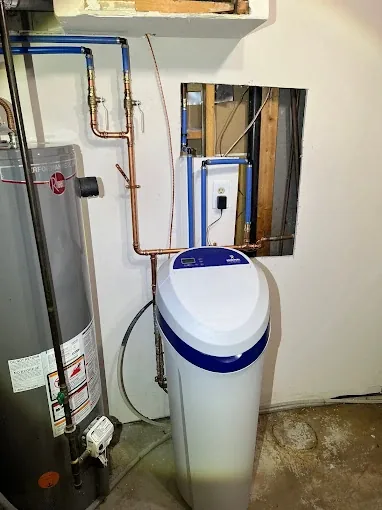
What you’re looking atA water softener, installed to code
- Control valve
Decides when to regenerate. MPCA recommends demand-based units, which regenerate only after a set amount of water is used, over timer-based ones.
- Bypass valve
Minnesota code requires isolation valves and a bypass on every softener, so it can be serviced without shutting off the house.
- Resin tank
Resin beads trade sodium for the calcium and magnesium that make water hard. MDH says a softener may be needed above 7 grains per gallon.
- Brine tank
Holds the salt that recharges the resin. Wastewater plants can’t remove chloride from brine, so it ends up in Minnesota lakes and rivers.
- Drain & air gap
Regeneration water has to enter the drain through an air gap, never a direct connection.
- Scale inside a pipe
What hard water does over time: mineral scale narrows pipes and coats water heater tanks and fixtures.
01The short answer
Soften the water. Use less salt doing it.
In one paragraph
MDH says a softener may be needed when hardness tops 7 grains per gallon, and most north-metro city water is two to three times that. A correctly sized, demand-based softener set to your real hardness protects pipes and the water heater while using far less salt than an old timer-based unit.
Hard water leaves scale in pipes, water heaters, fixtures and appliances. A softener removes the calcium and magnesium; the real question is how much salt it uses doing it. In one Minnesota study, residents who replaced or tuned their softeners cut their annual salt use by 86 percent, according to MPCA.
What an install includes
- Isolation valves and a bypass, as code requires
- A regeneration drain through an air gap
- Unions for service, plus the bonding jumper Coon Rapids requires across a softener on copper piping
- Settings for your actual hardness, iron and household size
- Toilets, hose bibs and other cold taps left off the softened loop where practical, as MDH suggests
A licensing note
Licensed plumbers can do water conditioning work in Minnesota without a separate license; others need a water conditioning license or registration from the Department of Labor and Industry.
02Symptoms
Is your softener actually working?
The signs a softener needs service, settings or replacing.
| What you notice | What it usually means | How soon to call |
|---|---|---|
| Scale on faucets and showerheads | Hard water is getting past the softener, or there isn’t one. | When convenient |
| Salt level never goes down | A salt bridge in the brine tank, or the softener isn’t regenerating. | This week |
| Brine tank full of water | A clogged drain line or injector, or a float problem. | This week |
| Water feels hard again | Exhausted resin, the wrong hardness setting, or a bypass left open. | This week |
| Salty-tasting water | A rinse or regeneration problem in the control valve. | This week |
| Orange or rust stains | Iron the softener isn’t handling. Ramsey’s utility recommends iron filters and softeners for iron staining. | When convenient |
03Service or replace
Service it, or replace it?
Service it if
- The resin tank and valve are sound
- It’s a settings, drain line or salt-bridge problem
- It’s already demand-based
Replace it if
- It’s an old timer-based unit using more salt than it needs
- The control valve has failed and parts are scarce
- It’s undersized for your household or your hardness
MPCA advises having a professional check softener settings every couple of years.
04Minnesota field notes
Hard water and salt, by the numbers.
Rules and numbers that apply to homes here, each with its source.
When to soften
7 gpg
MDH says a water softener may be needed when hardness exceeds 7 grains per gallon (120 mg/L).
Source: Minnesota Department of Health, Home Water Softening FAQ
Coon Rapids water
16–18 gpg
Coon Rapids tells residents setting up a softener to use 16–18 grains per gallon of hardness, pH 7, and iron of 0–0.3 ppm.
Drain rule
Air gap
Water softener regeneration water must enter the drain through an air gap.
Service valves
Bypass
Every softener installation needs isolation valves and a bypass so it can be serviced without shutting off the home’s water.
Chloride
68 waters
MPCA counts 68 Minnesota lakes and streams over the state’s chloride standard. One teaspoon of salt permanently pollutes five gallons of water.
Coon Rapids rule
Bonding
Coon Rapids requires a bonding jumper wire across the softener on copper water piping, plus unions for service.
Checked October 2026. Codes and city rules change; your permit office has the final word.
05Real work
Softeners installed and explained.
Denis did an excellent job with installing our water softener. Prior to the job he answered all of my questions and helped me understand the problem. After installing a new softener he gave me a small tutorial on how to best maintain it.
VarunGoogle review · Jun 2024
“Great job done by Denis, showed up when he said he was going to and got things done in a timely manner, water softener installation looks good!”
John M. · Google review · Jun 2025
06Questions
Water softeners questions, answered.
Straight answers, with the source when a rule or number is involved. Still not sure? Call and describe it.
QDo I need a water softener in Coon Rapids?
Most homes benefit from one. Coon Rapids city water measures 16–18 grains per gallon of hardness, and the Minnesota Department of Health says a softener may be needed above 7. The city’s treatment plants remove iron and manganese but don’t soften the water.
Source: City of Coon Rapids; Minnesota Department of Health
QHow hard is the water in the north metro?
Per each city’s published water information: New Brighton 24 grains per gallon, Blaine 18–21, Coon Rapids 16–18, Mounds View 17, Fridley 12–17, Ramsey 15–17, Shoreview 15, Lino Lakes 14.8 and Andover 13. Columbia Heights buys Minneapolis water, which is much softer at about 4.5 grains.
Source: City water reports and utility pages, checked October 2026
QHow can I make my softener use less salt?
Replace an old timer-based unit with a demand-based softener that regenerates only after a set amount of water is used, set it to your actual hardness, and have the settings checked every couple of years. In one Minnesota study, residents cut salt use 86 percent this way.
Source: MPCA, Use less salt in your water softener (2024)
QDoes softened water affect my water heater?
It can. A.O. Smith warns that artificially softened water can be very corrosive and that overly soft water may shorten tank life, so with softened water it calls for checking the anode rod every year. Setting the softener to your real hardness avoids over-softening.
Source: A.O. Smith installation guide
QCan I have a water softener on a septic system?
Yes, but University of Minnesota guidance is to route water softener and iron filter recharge water outside the septic system. That applies across Ham Lake and other unsewered parts of the north metro.
Source: University of Minnesota Onsite Sewage Treatment Program
QIs softened water safe to drink?
Salt-based softening raises the sodium in drinking water, so the Minnesota Department of Health advises people with high blood pressure to talk with their doctor. MDH also notes cold taps like the kitchen drinking tap can be left unsoftened.
Source: Minnesota Department of Health, Home Water Softening FAQ
07Related
Often the same visit. Often the same wall.
- B1Water heatersTank and tankless water heaters repaired and replaced to code.
- 2FLow water pressureWeak showers and slow fills traced to the valve, regulator or pipe causing them.
- WALLPipesBurst, frozen, corroded and leaking pipes repaired or replaced.
- B1PumpsSump pumps, battery backups and check valves.
- Coon Rapids
- Anoka
- Champlin
- Ramsey
- Andover
- Ham Lake
- Blaine
- Lexington
- Lino Lakes
- Spring Lake Park
- Mounds View
- Shoreview
- New Brighton
- Fridley
- Columbia Heights
Each city page has that city’s own water report numbers, permit rules and sewer-line responsibilities.

08Call us
Call the people who know your house inside out.
(612) 245‑7341Mon – Sat · 8 AM – 10 PM
- Hours
- Monday – Saturday, 8 AM – 10 PM · Sunday closed
- Address
- 12433 Uplander St NW, Coon Rapids, MN 55448
- Serving
- Coon Rapids and 14 north‑metro cities · see the map