

YARD · Under the lawn · Coon Rapids & north metro
Camera inspections, inside the sewer line.
AP Plumbing runs a camera through drains and sewer lines in Coon Rapids and the north metro to show what’s wrong and where: roots, cracks, sags, breaks or buildup. Use it before a repair, before buying an older home, or when your city requires sewer televising at sale.
5.0 · 513 Google reviews
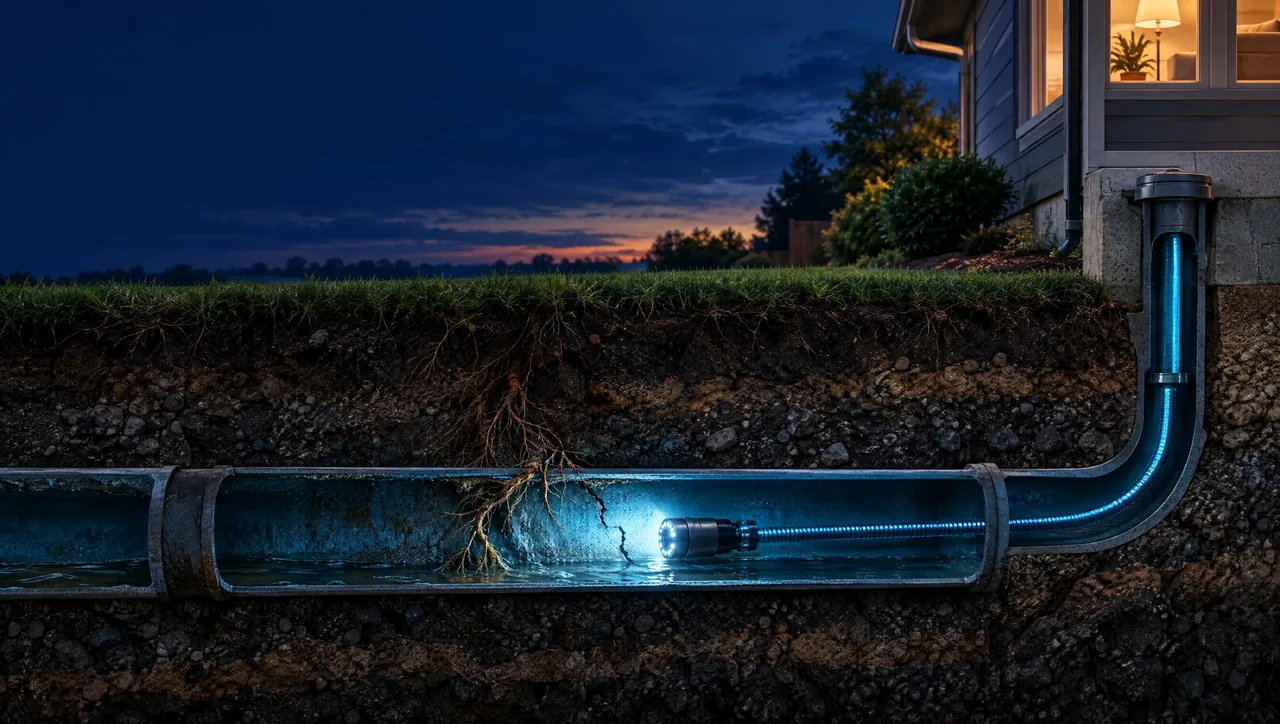
What you’re looking atA camera inside the sewer lateral
- Cleanout
The access point near where the building drain meets the sewer. Minnesota code requires a cleanout there, and it’s where camera inspections usually start.
- Push cable
A flexible cable pushes the camera down the line, and the picture shows on a monitor above ground as it goes.
- Pipe joint
Joints are where roots get in and where old pipe separates or offsets.
- Camera head
A small lit camera that shows the inside of the pipe: roots, cracks, sags, grease and anything that shouldn’t be there.
- Crack & roots
The Met Council says up to 80% of the clear water leaking into Twin Cities sewers comes from private property, like cracked or root-damaged service lines.
01The short answer
See the problem before anyone digs.
In one paragraph
A sewer camera turns a guess into a picture. It shows whether a backup is roots, a sag, a break or buildup, and how far from the cleanout it is, so a repair can be planned instead of guessed. Mounds View and Columbia Heights require sewer televising before a home sale.
When a main line keeps clogging, clearing it again is a temporary answer; a camera shows the cause. It’s also cheap due diligence on an older house. The Met Council’s task force reports that an average sewer lateral repair can cost $8,000 or more.
When cities require it
Mounds View requires sewer laterals to be televised before a property changes hands (Ordinance 967), and Columbia Heights runs a time-of-sale sewer televising program. The Met Council notes that most metro cities don’t have a point-of-sale requirement.
Help paying for repairs
The Met Council’s 2026 private property inflow and infiltration grant, run through participating cities, can cover 50% of eligible sewer lateral repair costs up to $5,000, or $10,000 for qualifying owners. Camera and cleaning costs count only when they lead to a repair.
02When to inspect
When a camera pays for itself.
Situations where seeing inside the line beats guessing.
| Situation | What the camera answers | Timing |
|---|---|---|
| The main line has backed up more than once | Whether it’s roots, a sag, a break or buildup, and where. | Before the next clearing |
| Buying an older home | The condition of the sewer lateral. The Met Council says a home’s age is the best clue to what the pipe is made of. | Before closing |
| Selling in Mounds View or Columbia Heights | Sewer televising is required before the sale. | Before listing |
| Big trees between the house and the street | Whether roots are already in the joints. | When clogs start |
| Adding a bathroom | Whether the existing line is sound enough to carry more. | At design |
| Sewage smell or a soggy spot over the line | Cracks or breaks letting sewage out. | This week |
03Minnesota field notes
Sewer laterals, by the numbers.
Rules and numbers that apply to homes here, each with its source.
Met Council advice
Inspect
The Metropolitan Council advises homeowners to have a plumber inspect their sewer service line for root intrusion and cracks.
Source: Metropolitan Council, PSA No. 3
Private property
Up to 80%
Up to 80% of inflow and infiltration comes from private infrastructure such as cracked or root-damaged sewer service lines.
Source: Metropolitan Council, PSA No. 3
Repair cost
$8,000+
The Met Council’s task force reported that an average sewer lateral repair can cost $8,000 or more.
Source: Metropolitan Council, 2023 Private Property I/I Task Force Report
Grants
50% to $5,000
The 2026 private-property I/I grant can cover 50% of eligible lateral repair costs up to $5,000 (up to $10,000 for qualifying owners).
Source: Metropolitan Council, Private Property I/I Grant Program
Mounds View
At sale
Mounds View Ordinance 967 requires the sewer lateral to be televised before transfer of title, and repaired if needed.
Access
Cleanout
Code requires a cleanout near the junction of the building drain and the building sewer, the usual entry point for a camera.
Checked October 2026. Codes and city rules change; your permit office has the final word.
04Real work
Found on camera, fixed for good.
Dennis is very good at communicating his findings and offering solutions. He and his team were extremely friendly and efficient with getting my main sewer line fixed. They had everything done in one day.
Shannon S.Google review · Mar 2025
“he actually delayed the job a couple of days so he could order a special tool, which allowed him to remove the pipe instead of breaking up concrete. … He came back with his apprentice and the two of them did an excellent job fixing a waste pipe that had been slowly leaking into our basement for years.”
Jeremy S. · Google review · Mar 2026
“Denis was great. We had a leak in our sewer drain line and he came out the same day to fix it. Very professional and courteous.”
Danny · Google review · Dec 2024
05Questions
Video camera inspections questions, answered.
Straight answers, with the source when a rule or number is involved. Still not sure? Call and describe it.
QWhat does a sewer camera inspection show?
A sewer camera shows the inside of the drain or sewer line in real time: roots in the joints, cracks, breaks, offset or separated joints, sags that hold water, and grease or scale buildup. It also shows how far each problem is from the cleanout, so a repair can be located precisely.
QShould I get a sewer inspection before buying a house?
For an older home, yes. The Met Council says a home’s age is the closest clue to what its sewer lateral is made of, and its task force reports an average lateral repair can cost $8,000 or more, which the buyer inherits along with the house.
Source: Metropolitan Council, 2023 I/I Task Force Report
QIs a sewer inspection required to sell a house in Minnesota?
Not statewide, and most metro cities don’t require one. Some do: Mounds View requires the sewer lateral to be televised before a sale (Ordinance 967), and Columbia Heights runs a time-of-sale sewer televising program. Check with your city before listing.
Source: City of Mounds View; City of Columbia Heights; Metropolitan Council
QCan I get help paying for a sewer line repair?
Possibly. The Met Council’s 2026 private property I/I grant, offered through participating cities, can cover 50% of eligible sewer lateral repair costs up to $5,000, or $10,000 for qualifying owners. Camera and cleaning costs are eligible only when they lead to a repair.
Source: Metropolitan Council, Private Property I/I Grant Program
QWhere does the camera go into the sewer line?
Usually through the cleanout near where the building drain meets the sewer line, which Minnesota code requires. In some homes the camera goes in through a floor drain, a toilet flange or a roof vent instead.
Source: 2020 Minnesota Plumbing Code §719.1
06Related
Often the same visit. Often the same wall.
- YARDDrainsClogged sinks, tubs, floor drains and main sewer lines cleared.
- WALLLeak detectionHidden leaks found before walls get opened, then repaired.
- WALLPipesBurst, frozen, corroded and leaking pipes repaired or replaced.
- 2FBathroom & kitchen remodelingPermitted rough-in and finish plumbing for remodels.
- Coon Rapids
- Anoka
- Champlin
- Ramsey
- Andover
- Ham Lake
- Blaine
- Lexington
- Lino Lakes
- Spring Lake Park
- Mounds View
- Shoreview
- New Brighton
- Fridley
- Columbia Heights
Each city page has that city’s own water report numbers, permit rules and sewer-line responsibilities.

07Call us
Call the people who know your house inside out.
(612) 245‑7341Mon – Sat · 8 AM – 10 PM
- Hours
- Monday – Saturday, 8 AM – 10 PM · Sunday closed
- Address
- 12433 Uplander St NW, Coon Rapids, MN 55448
- Serving
- Coon Rapids and 14 north‑metro cities · see the map