

2F · Upstairs · Coon Rapids & north metro
Toilet repair & replacement.
AP Plumbing fixes running, leaking, clogged and rocking toilets and installs new ones, bidet seats included, in Coon Rapids and 14 north-metro cities. We check the parts you can’t see: the flapper and fill valve in the tank, and the wax ring and flange under the floor.
5.0 · 513 Google reviews
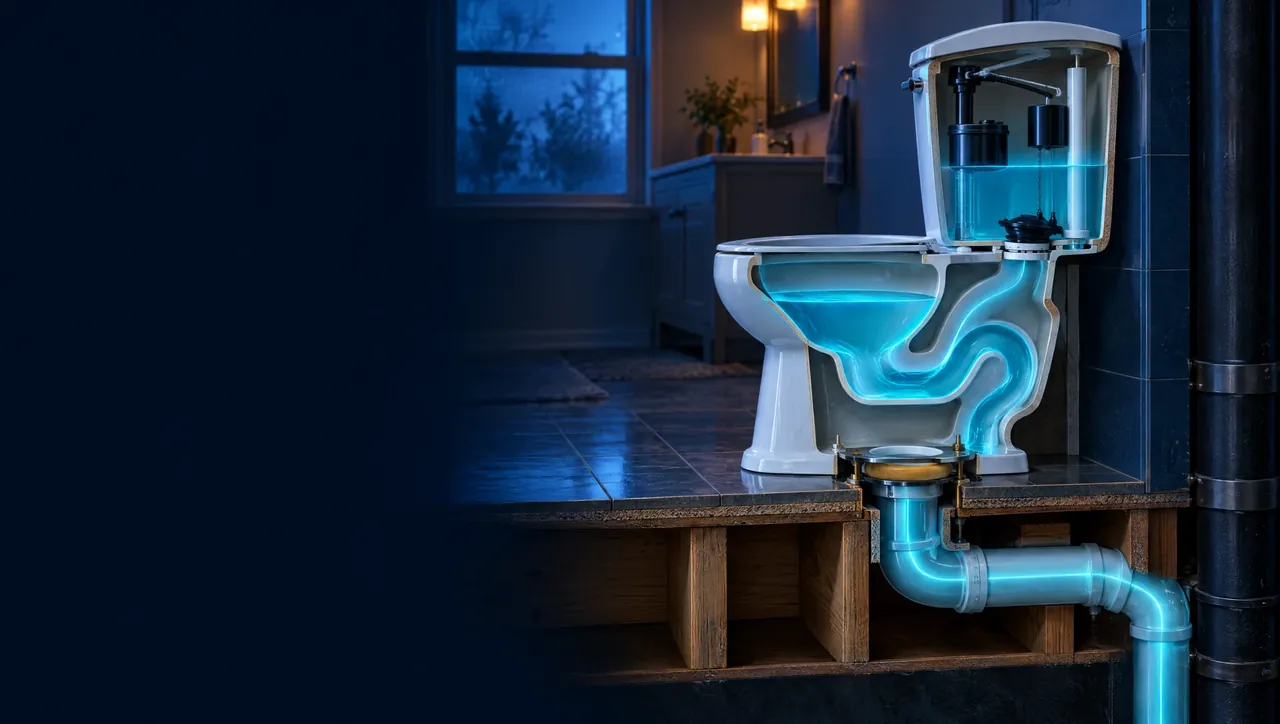
What you’re looking atA toilet, from tank to stack
- Fill valve
Refills the tank after a flush and shuts off at the set level. A worn one hisses, refills on its own or never quite stops.
- Flapper & flush valve
The rubber seal at the bottom of the tank. EPA says a worn flapper can make a toilet run on its own or leak silently, wasting thousands of gallons a year.
- Overflow tube
If the tank overfills, water spills down this tube into the bowl. Water running down it nonstop means the fill level is set too high or the fill valve is failing.
- Trapway
The curved channel that holds water as a seal against sewer gas. It’s also where most toilet clogs stop.
- Wax ring
Seals the toilet to the drain. When it fails you get water at the base, a sewer smell or a soft floor.
- Closet flange
Anchors the toilet to the floor and the drain. A cracked or loose flange lets the toilet rock and breaks the wax seal, so it gets repaired before a new ring goes on.
01The short answer
Most toilet problems are one part. Some are under the floor.
In one paragraph
A running or weak toilet is usually the flapper, fill valve or a partial clog. Water at the base means the wax ring or the flange beneath it. Cracked porcelain or constant clogs mean replacement, and a WaterSense model uses 1.28 gallons per flush or less.
A toilet has two parts that wear out inside the tank, the flapper and the fill valve, and two under it that don’t move but do fail, the wax ring and the flange. Most of the job is knowing which one you’re dealing with.
Running toilets waste more than you’d think
EPA says a worn flapper can make a toilet run on its own or leak silently, wasting thousands of gallons a year. Check yours with a dye test: put a few drops of food coloring in the tank, wait 10 minutes without flushing, and look for color in the bowl.
Replacing a toilet
- Old toilet out; the flange checked and repaired if it’s cracked or loose
- New wax ring and closet bolts, toilet set level and solid
- New supply line, and a new shutoff valve if the old one is seized
- Clearances to code: at least 15 inches from center to any side wall and 24 inches clear in front
02Symptoms
Running, rocking, leaking? Here’s what it means.
The common toilet problems, what’s usually behind them, and how soon to deal with them.
| What you notice | What it usually means | How soon to call |
|---|---|---|
| Refills on its own every so often | The flapper is letting water seep into the bowl, so the tank tops itself up. | This week |
| Never stops running | The fill valve isn’t shutting off, the water level is above the overflow tube, or the flapper is stuck. | This week |
| Water on the floor around the base | A failed wax ring, or a cracked or loose flange. Left alone it can rot the subfloor. | Today |
| Rocks when you sit on it | Loose closet bolts or a broken flange. Rocking breaks the wax seal. | This week |
| Clogs often or flushes weakly | A partial clog in the trapway, or a blockage further down the drain line. | This week |
| Gurgles when other drains run | A venting problem or a blockage in the main drain rather than the toilet itself. | This week |
| Sewer smell in the bathroom | A failed wax seal, a dried-out trap in an unused fixture, or a vent problem. | This week |
| Water backs up out of the toilet or floor drain | A main sewer line blockage. Stop running water and call. | Right now |
03Repair or replace
Fix the parts, or start fresh.
Repair it if
- The tank and bowl are uncracked
- The problem is a flapper, fill valve, handle, wax ring or flange
- It flushes well once the part is replaced
Replace it if
- The tank or bowl is cracked, even a hairline crack in the tank
- It clogs constantly after the line has been cleared
- It’s an old high-volume model: EPA says older toilets can use as much as 6 gallons per flush
Rebates on WaterSense toilets were open in several cities on our route as of October 2026: Fridley ($100), Lino Lakes (up to $100), Shoreview (75% of cost, up to $150) and Ramsey (up to $200). Check current terms with your city.
04Minnesota field notes
Toilet numbers that matter in Minnesota.
Rules and numbers that apply to homes here, each with its source.
Flush limit
1.6 gpf
Minnesota’s plumbing code caps toilets at 1.6 gallons per flush. WaterSense models use 1.28 gpf or less.
Clearances
15 in. · 24 in.
A toilet must sit at least 15 inches from its centerline to any side wall or obstruction, with 24 inches clear in front.
Biggest indoor user
~30%
Toilets are the largest indoor water user, nearly 30 percent of an average home’s indoor use.
Savings
13,000 gal
Replacing old toilets with WaterSense models can save an average family nearly 13,000 gallons and more than $170 a year.
Dye test
10 min
Put a few drops of food coloring in the tank. Color in the bowl after 10 minutes, without flushing, means a leak.
Source: EPA WaterSense, Fix a Leak Week
Local rebates
Up to $200
WaterSense toilet rebates were offered by Fridley, Lino Lakes, Shoreview and Ramsey as of October 2026, each with its own terms.
Checked October 2026. Codes and city rules change; your permit office has the final word.
05Real work
A leaking toilet, fixed from the floor up.
Dennis came out on time, explained all of the repairs needed and their associated costs. The leaking from my toilet was due to a worn out wax ring. During the replacement process, he discovered the flange needed to be repaired. He ensure the flange repair was stable, and then replaced the wax ring. Excellent work!
Robert Z.Google review · Mar 2025
“AP Plumbing was able to fit us in on the very next day to do our toilet replacement. He did an excellent job installing our new toto washlet bidet for a reasonable price. So far, everything has worked as expected.”
Jonathan H. · Google review · Sep 2026
“Denis & Dan were great! They got here on the early side of their time window & got our new toilet installed quickly. Friendly & easy to work with!”
Maria N. · Google review · Jan 2026
“Denis came out and helped with a clogged toilet issue. Quick and efficient solved my issue and was very nice in the price”
Michael F. · Google review · Jul 2026
06Questions
Toilets questions, answered.
Straight answers, with the source when a rule or number is involved. Still not sure? Call and describe it.
QWhy does my toilet keep running?
Usually the flapper isn’t sealing, so water seeps into the bowl and the tank keeps refilling, or the fill valve isn’t shutting off and water spills into the overflow tube. Both are replaceable parts. A dye test, food coloring in the tank for 10 minutes, shows a flapper leak.
Source: EPA WaterSense, Fix a Leak Week
QWhy is water leaking around the base of my toilet?
Water at the base usually means the wax ring that seals the toilet to the drain has failed, often because the toilet rocked or the flange under it is cracked or loose. The fix is pulling the toilet, repairing the flange if needed, and resetting it on a new wax ring.
QHow much water does a new toilet save?
EPA says replacing older toilets with WaterSense models cuts toilet water use by 20 to 60 percent, nearly 13,000 gallons a year and more than $170 in water costs for an average family. Older toilets can use as much as 6 gallons per flush; WaterSense models use 1.28 or less.
Source: EPA WaterSense, Residential Toilets
QCan you install a bidet seat or a new toilet the next day?
We install new toilets and bidet seats; one recent customer had us put in a TOTO Washlet. Timing depends on the schedule that week, so call and we’ll give you a real time. Most bidet seats also need an electrical outlet near the toilet.
QHow far from the wall does a toilet have to be?
Minnesota’s plumbing code requires at least 15 inches from the center of the toilet to any side wall or obstruction, and at least 24 inches of clear space in front. Most toilets are made for a 12-inch rough-in, measured from the finished back wall to the center of the drain.
Source: 2020 Minnesota Plumbing Code §402.5
07Related
Often the same visit. Often the same wall.
- 2FFaucetsDripping or failing faucets, fixed or swapped, with new shutoff valves where needed.
- YARDDrainsClogged sinks, tubs, floor drains and main sewer lines cleared.
- 2FLow water pressureWeak showers and slow fills traced to the valve, regulator or pipe causing them.
- 2FBathroom & kitchen remodelingPermitted rough-in and finish plumbing for remodels.
- Coon Rapids
- Anoka
- Champlin
- Ramsey
- Andover
- Ham Lake
- Blaine
- Lexington
- Lino Lakes
- Spring Lake Park
- Mounds View
- Shoreview
- New Brighton
- Fridley
- Columbia Heights
Each city page has that city’s own water report numbers, permit rules and sewer-line responsibilities.

08Call us
Call the people who know your house inside out.
(612) 245‑7341Mon – Sat · 8 AM – 10 PM
- Hours
- Monday – Saturday, 8 AM – 10 PM · Sunday closed
- Address
- 12433 Uplander St NW, Coon Rapids, MN 55448
- Serving
- Coon Rapids and 14 north‑metro cities · see the map