


B1 · Utility room · Coon Rapids & north metro
Water heater repair & replacement.
AP Plumbing repairs and replaces tank and tankless water heaters for homes in Coon Rapids and 14 north-metro cities. We find what failed before quoting, and replacements go in with the relief line, gas shutoff and expansion tank Minnesota code calls for.
5.0 · 513 Google reviews
What you’re looking atA gas tank water heater, cut open
- Thermal expansion tank
Water expands as it heats. If a check valve or pressure regulator keeps it from backing into the city main, Minnesota code requires an expansion tank (or similar device) to absorb it.
- T&P relief valve
Opens if tank temperature or pressure gets dangerous. A.O. Smith says to operate it by hand at least once a year. A drip often points to thermal expansion or high water pressure.
- Relief discharge pipe
Must drain by gravity to a safe place or end within 18 inches of the floor, with no valve and no threaded end (Minnesota Rules 4714.0608).
- Anode rod
A sacrificial rod that corrodes so the steel tank doesn’t. Once it’s used up, the tank starts to rust and will eventually leak. Softened water wears it faster.
- Sediment on the tank floor
Hard-water minerals settle here and make the tank rumble and pop. Coon Rapids water runs 16–18 grains of hardness, so sediment builds quickly.
- Gas shutoff & burner
Coon Rapids wants the gas shutoff within 6 feet of the water heater and unions on the gas and water lines so the unit can be serviced.
01The short answer
Fix it or replace it? We’ll tell you which, and why.
In one paragraph
Most water heater problems are a part: a gas valve, thermocouple, element, thermostat or relief valve. Those get repaired. A tank that leaks from the steel itself can’t be patched, and that’s when replacement is the answer.
Water heaters fail in two ways. Parts wear out, and tanks rust through. A part is a repair. A tank leaking from its own shell, usually after the anode rod is used up, means a new heater.
What a visit looks like
- We look at the tank, the venting, the gas or electric supply and the relief line before giving you a price.
- You get the options in plain terms: what we can fix today, and what replacement would involve.
- Replacements are permitted where the city requires it, and installed with the relief line, expansion control and shutoffs code requires.
- We clean up before we leave, and show you what we did.
Tank, tankless or heat pump
Tank heaters are the most common in north-metro basements. ENERGY STAR puts tankless water heater life expectancy at about 20 years, longer than tank-type heaters, and an ENERGY STAR heat pump water heater can save a household of four about $550 a year in electricity compared with a standard electric tank. We’ll talk through what fits your space, venting and budget.
02Symptoms
Is it the water heater? Read the symptoms.
What homeowners notice first, what it usually means, and how soon to call.
| What you notice | What it usually means | How soon to call |
|---|---|---|
| Water pooling around the base | A leaking fitting or relief valve, or the tank itself. A leak from the steel tank can’t be repaired. | Today |
| Relief valve dripping, or its pipe is wet | Thermal expansion or high water pressure, per A.O. Smith. Sometimes a worn valve. | This week |
| Rumbling or popping while it heats | Sediment on the tank floor boiling under the water. Common with hard water. | This week |
| Hot water runs out faster than it used to | Sediment taking up space, a broken dip tube, or a burner or element problem. | This week |
| Rotten-egg smell from hot water only | Hydrogen sulfide from a reaction with the anode rod. A different anode usually fixes it. | When convenient |
| Rusty hot water, clear cold water | Corrosion inside the tank, or sediment stirred up after city hydrant flushing. | This week |
| Gas smell near the heater | Leave the house, then call your gas utility or 911 from outside. Don’t touch switches. | Right now |
03Repair or replace
The tank, the age, and the repair bill decide it.
Repair it if
- The tank itself is dry and sound
- It’s a part: gas valve, thermocouple, igniter, element, thermostat, relief valve or dip tube
- It has been reliable and heats consistently
Replace it if
- Water is leaking from the tank shell
- It’s 10+ years old and heating inconsistently (ENERGY STAR’s rule of thumb)
- You’re facing repeat repairs, or you need more hot water than it makes
Replacing? Coon Rapids’ Green Homes Program matched 50% of a utility water heater rebate, up to $250, as of July 2025. Check current terms with the city before you buy.
04Minnesota field notes
The rules a water heater has to meet here.
Rules and numbers that apply to homes here, each with its source.
Coon Rapids permits
Required
Coon Rapids requires a plumbing permit to replace a water heater, along with softeners, dishwashers, disposals, sinks and tub/showers.
Relief line
≤ 18 in.
The relief valve discharge must drain by gravity to a safe place or end within 18 inches of the floor. No valves, no threaded end, never into a crawl space.
Source: Minnesota Rules 4714.0608
Expansion control
Closed systems
Homes with a check valve, backflow preventer or similar device need a listed, adequately sized expansion tank or equivalent.
Coon Rapids install rules
6 ft · 18 in.
Gas shutoff within 6 feet of the appliance, a full-way valve on the cold inlet, and no PEX within 18 inches of the heater.
Scald risk
125°F
Water hotter than 125°F can cause severe burns instantly. Setting matters more than most people think.
Source: A.O. Smith gas water heater installation & care guide
Tankless lifespan
~20 yrs
ENERGY STAR puts tankless water heater life expectancy at about 20 years, longer than any conventional tank-type heater.
Checked October 2026. Codes and city rules change; your permit office has the final word.
05Real work
Old tank out, new one in. In customers’ words.
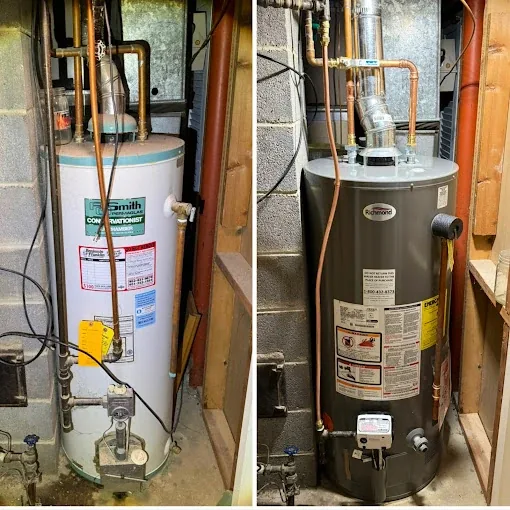
We called Denis when our 20 year-old water heater finally bit the dust. Denis was out within a couple of hours to give us a quote, and was able to replace the entire unit and bring our plumbing up to code the same day.
Megan H.Google review · Apr 2025
“They got back to me the same day and were able to replace my water heater the very next day. … their pricing was significantly better than what I was quoted by the larger company.”
Mikayla P. · Google review · Sep 2026
“CenterPoint came out and yellow tagged our water heater. … They just wrapped up the job, and I’m honestly blown away. The work is flawless. The craftsmanship is top tier. And somehow the area is cleaner now than before they arrived.”
Joshua E. · Google review · Nov 2025
06Questions
Water heaters questions, answered.
Straight answers, with the source when a rule or number is involved. Still not sure? Call and describe it.
QHow do I know if my water heater needs to be replaced?
Replace it when the tank itself is leaking, since a corroded tank can’t be repaired, or when it’s around 10 years old and no longer heating consistently, which ENERGY STAR flags as a sign of decline. Most other problems, like a bad gas valve, thermocouple, element or relief valve, are repairable.
QDo I need a permit to replace a water heater in Coon Rapids?
Yes. Coon Rapids lists water heater replacement among the plumbing jobs that require a permit, along with water softeners, dishwashers and garbage disposals. Blaine, Andover, Anoka and most neighboring cities also require one. The inspection checks the gas line, venting and relief valve discharge.
Source: City of Coon Rapids, Residential Plumbing Requirements
QWhy is my water heater’s relief valve dripping?
Usually thermal expansion or high water pressure. Water expands as it heats, and if a check valve or pressure regulator stops it from flowing back to the city main, pressure builds until the relief valve lets some out. An expansion tank solves the expansion problem; a worn valve gets replaced.
Source: A.O. Smith installation guide; 2020 Minnesota Plumbing Code §608.3
QHow often should I flush my water heater?
A.O. Smith recommends draining and flushing a tank every six months to remove sediment. North-metro water is hard, about 16–18 grains per gallon in Coon Rapids, so sediment builds fast. Blaine’s water utility recommends flushing every one to three years at minimum.
QHow long do tankless water heaters last?
ENERGY STAR puts tankless water heater life expectancy at about 20 years, longer than conventional tank heaters. An ENERGY STAR gas tankless model also saves a family of four about $95 a year compared with a gas storage heater, or about $1,800 over its life.
Source: ENERGY STAR, gas tankless water heaters
QWhy does my hot water smell like rotten eggs?
That smell usually comes from hydrogen sulfide produced by a reaction between the tank’s anode rod and the water, according to A.O. Smith. It shows up in the hot water only. Replacing the anode with a different type usually solves it.
07Related
Often the same visit. Often the same wall.
- B1Water softenersSoftener installs and repairs for the north metro’s hard water.
- B1Gas linesNew gas lines and appliance hookups, pressure-tested.
- WALLLeak detectionHidden leaks found before walls get opened, then repaired.
- 2FLow water pressureWeak showers and slow fills traced to the valve, regulator or pipe causing them.
- Coon Rapids
- Anoka
- Champlin
- Ramsey
- Andover
- Ham Lake
- Blaine
- Lexington
- Lino Lakes
- Spring Lake Park
- Mounds View
- Shoreview
- New Brighton
- Fridley
- Columbia Heights
Each city page has that city’s own water report numbers, permit rules and sewer-line responsibilities.

08Call us
Call the people who know your house inside out.
(612) 245‑7341Mon – Sat · 8 AM – 10 PM
- Hours
- Monday – Saturday, 8 AM – 10 PM · Sunday closed
- Address
- 12433 Uplander St NW, Coon Rapids, MN 55448
- Serving
- Coon Rapids and 14 north‑metro cities · see the map