


2F · Upstairs · Coon Rapids & north metro
Faucet repair & replacement.
AP Plumbing repairs and replaces kitchen, bathroom and utility-sink faucets in Coon Rapids and 14 north-metro cities. Most drips are a worn cartridge or seal. When the faucet itself is done, we replace it, along with any seized shutoff valves under the sink.
5.0 · 513 Google reviews
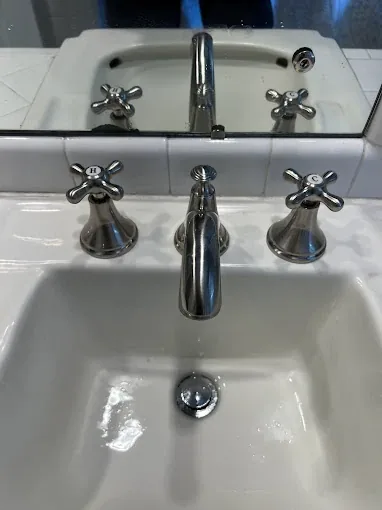
What you’re looking atA bathroom sink, valve to trap
- Cartridge
The valve inside the handle that mixes hot and cold. Worn cartridges cause most drips and stiff handles, and many can be replaced without changing the faucet.
- Spout & aerator
The aerator screen can clog with mineral flakes and cut your flow. EPA says a faucet dripping once a second can waste more than 3,000 gallons a year.
- Supply lines
Braided lines carry water from the valves to the faucet. Old rubber or plastic lines can split, so they get replaced with the faucet.
- Shutoff valves
Minnesota code requires a shutoff ahead of each fixture. Old multi-turn valves often seize or drip the day you finally need them.
- Pop-up drain
The rod and stopper that open and close the drain. A loose nut here is a common slow leak inside the cabinet.
- P-trap
Holds a little water to block sewer gas. Its slip nuts are a common leak point, and it’s where rings and hair get caught.
01The short answer
Repair the cartridge, or replace the faucet.
In one paragraph
A dripping faucet usually needs a new cartridge or seals. If the body is corroded, the finish is failing or parts aren’t available, a new faucet is the better buy, and that’s the time to replace stiff or seized shutoff valves too.
Faucets wear out at their moving parts: the cartridge or valve stem, the O-rings and seals, and the aerator. Most of that is repairable. Corrosion in the body, a failing finish and old valves that won’t close are what make replacement the smarter call.
Older homes and lead
The Minnesota Department of Health says homes built before 1986 may have plumbing parts that contain lead. Minnesota code now requires faucets and fittings that carry drinking water to meet the lead-free limit of 0.25% weighted-average lead, so a new faucet is an easy upgrade.
What we work on
- Kitchen faucets, including pull-down and pull-out sprayers
- Bathroom faucets: single-handle, centerset and widespread
- Laundry and utility-sink faucets
- New supply lines and quarter-turn shutoff valves
02Symptoms
Drip, trickle or puddle? Here’s the likely cause.
Match what you’re seeing to what’s usually wrong.
| What you notice | What it usually means | How soon to call |
|---|---|---|
| Drips after you shut it off | A worn cartridge, washer or seal inside the valve. | This week |
| Water inside the sink cabinet | A loose supply line, a failing shutoff valve, or the drain’s slip nuts. | Today |
| Low flow at one faucet only | A clogged aerator or a blocked cartridge. If every fixture is weak, see low water pressure. | When convenient |
| Handle is stiff or hard to turn | Mineral buildup in the cartridge, or the cartridge is wearing out. | When convenient |
| Leaks from the base of the spout | Worn O-rings on the spout. | This week |
| Temperature jumps while it runs | A worn cartridge in a single-handle faucet. | When convenient |
| Shutoff valve won’t turn, or drips | An old multi-turn valve that has seized. Replace it before you need it. | This week |
03Repair or replace
A drip doesn’t always mean a new faucet.
Repair it if
- It’s a brand with replacement cartridges available
- The body and finish are in good shape
- The problem is a drip, a stiff handle or a clogged aerator
Replace it if
- The body is corroded or cracked
- Parts aren’t available, or it keeps needing repairs
- You’re updating the sink or counter anyway, or it predates 1986 and you want lead-free
04Minnesota field notes
Faucet rules and numbers worth knowing.
Rules and numbers that apply to homes here, each with its source.
Drip math
3,000 gal
A faucet dripping once per second can waste more than 3,000 gallons a year.
Source: EPA WaterSense, Fix a Leak Week
Lead-free
0.25%
Faucets and fittings that deliver drinking water must meet the lead-free limit of 0.25% weighted-average lead on wetted surfaces.
Older homes
Pre-1986
Homes built before 1986 may have lead-containing plumbing parts; a 1986 law restricted lead in plumbing and 2014 made it stricter.
Source: Minnesota Department of Health, Lead in Drinking Water
Shutoffs
Every fixture
Minnesota code requires a control valve immediately ahead of each fixture supply and each water-supplied appliance.
Flow limit
2.2 gpm
Bathroom and kitchen faucets are capped at 2.2 gallons per minute at 60 psi under Minnesota code.
WaterSense
1.5 gpm
WaterSense bathroom faucets flow at no more than 1.5 gpm and can save an average family about 700 gallons a year.
Source: EPA WaterSense, Bathroom Faucets
Checked October 2026. Codes and city rules change; your permit office has the final word.
05Real work
New faucets, new valves, no more drip.
AP plumbing was excellent! Denis and his apprentice were prompt and professional in their service. Did an excellent job replacing two faucets, fixed a leak in another faucet, and installed two shut off valves. Would highly recommend!
Chris C.Google review · Nov 2025
“Us being new home owners and not knowing what exactly happened to our kitchen faucet. Denis Paskar was able to find the problem and give us running water again, thank you.”
Sabrina C. · Google review · Jan 2026
“Denis demonstrated both speed and reliability in his service. He efficiently repaired our leaking bath faucet and promptly replaced our main shut-off valve, showcasing his skills and expertise in plumbing. We will be calling him for future plumbing needs!”
Fong V. · Google review · Sep 2025
“Not only did they come out and fix my sink, they came early … as a new resident to the midwest, he took the time to explain all my water shutoff valves and that I knew how to prepare my home for winter, no charge.”
Melody J. · Google review · Aug 2026
06Questions
Faucets questions, answered.
Straight answers, with the source when a rule or number is involved. Still not sure? Call and describe it.
QShould I repair or replace a dripping faucet?
Repair it if replacement cartridges are available and the body and finish are in good shape; most drips are a worn cartridge or seal. Replace it if the body is corroded, parts are unavailable, it keeps failing, or you’re remodeling anyway.
QHow much water does a dripping faucet waste?
EPA says a faucet dripping once per second can waste more than 3,000 gallons a year. That’s a small cartridge or seal repair, and it shows up on the water bill.
Source: EPA WaterSense, Fix a Leak Week
QDo new faucets have to be lead-free in Minnesota?
Yes. Faucets and fittings that deliver drinking water must meet the lead-free limit of 0.25% weighted-average lead under the Minnesota Plumbing Code. The Minnesota Department of Health notes that homes built before 1986 may still have lead-containing plumbing parts.
Source: 2020 Minnesota Plumbing Code §604.2; Minnesota Department of Health
QWhy is the water pressure low at just one faucet?
When only one faucet is weak, it’s almost always that faucet: a clogged aerator or a blocked or worn cartridge. If every faucet and shower is weak, the cause is upstream, such as a valve at the meter, the pressure-reducing valve or old galvanized pipe.
QCan you replace the shutoff valves under my sink?
Yes. Minnesota code requires a shutoff valve ahead of each fixture, and old multi-turn valves often seize or drip when you finally turn them. We replace them with quarter-turn valves, often in the same visit as a faucet.
07Related
Often the same visit. Often the same wall.
- 2FToiletsRunning, leaking, clogged or wobbling toilets, repaired or replaced.
- 2FLow water pressureWeak showers and slow fills traced to the valve, regulator or pipe causing them.
- 1FGarbage disposalsJammed, leaking or dead disposals repaired or replaced.
- 2FBathroom & kitchen remodelingPermitted rough-in and finish plumbing for remodels.
- Coon Rapids
- Anoka
- Champlin
- Ramsey
- Andover
- Ham Lake
- Blaine
- Lexington
- Lino Lakes
- Spring Lake Park
- Mounds View
- Shoreview
- New Brighton
- Fridley
- Columbia Heights
Each city page has that city’s own water report numbers, permit rules and sewer-line responsibilities.

08Call us
Call the people who know your house inside out.
(612) 245‑7341Mon – Sat · 8 AM – 10 PM
- Hours
- Monday – Saturday, 8 AM – 10 PM · Sunday closed
- Address
- 12433 Uplander St NW, Coon Rapids, MN 55448
- Serving
- Coon Rapids and 14 north‑metro cities · see the map