

B1 · Utility room · Coon Rapids & north metro
Gas lines, installed and pressure-tested.
AP Plumbing installs and relocates gas lines and hooks up gas ranges, dryers, water heaters and other gas appliances in Coon Rapids and the north metro. New piping is pressure-tested before it’s put in service, and CSST is bonded as the fuel gas code requires. If you smell gas, leave first and call your utility.
5.0 · 513 Google reviews
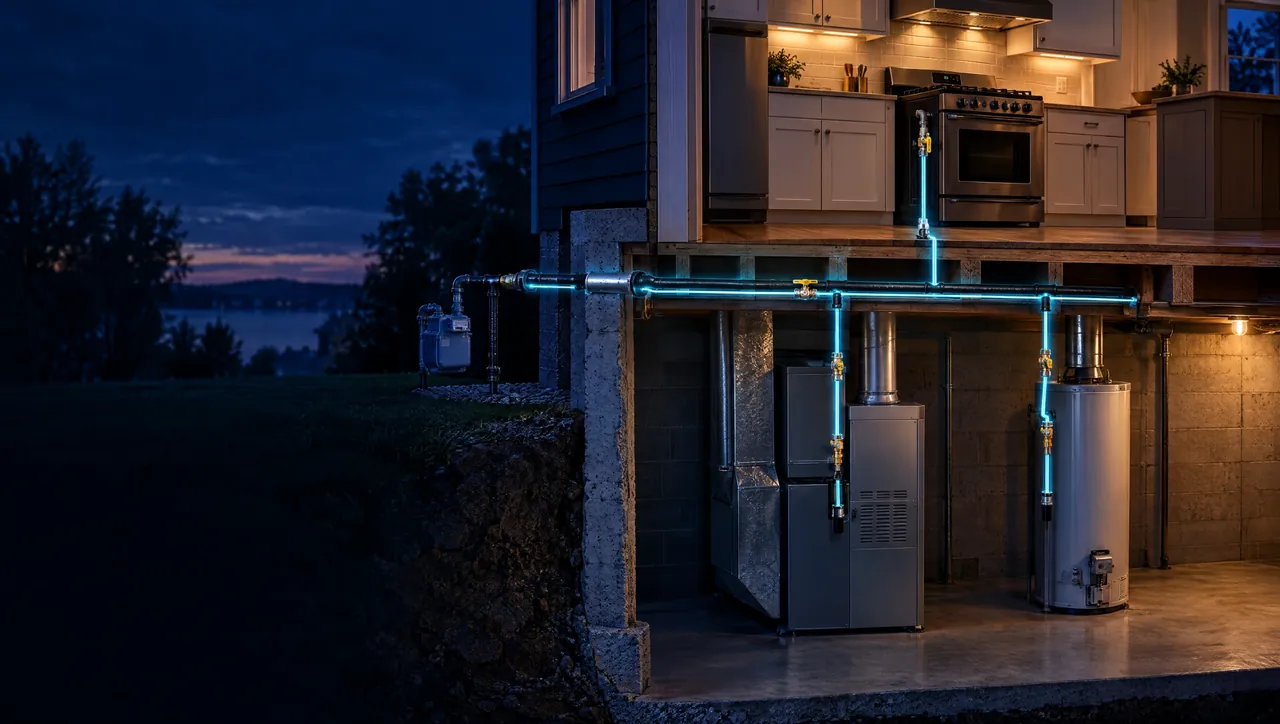
What you’re looking atA home’s gas piping, meter to range
- Gas meter
The utility’s meter. Piping after it belongs to the house. If you smell gas, leave and call the utility or 911 from outside.
- Main line
Black iron or CSST carries gas to each appliance. New piping is pressure-tested at 1.5 times working pressure, never below 25 psig.
- Shutoff valve
Every appliance gets its own shutoff. Coon Rapids wants the gas shutoff within 6 feet of a water heater.
- Sediment trap
A drip leg ahead of the appliance catches debris and moisture before they reach the gas valve.
- Water heater line
For appliance replacements and minor repairs, Minnesota’s fuel gas code allows inspection plus a leak-detecting fluid test at the connections instead of a full pressure test.
- Range connection
A flexible appliance connector with its own shutoff behind the range. Moving a range means moving this connection.
01The short answer
Gas work is permits, pressure tests and patience.
In one paragraph
Adding or moving a gas line means a permit, pipe sized for the load, a pressure test before it goes into service, and bonding for CSST. In Coon Rapids, a new gas opening needs a separate mechanical permit from the plumbing permit.
Most gas calls are additions and moves: a range in a remodeled kitchen, a dryer in a relocated laundry room, a line for a garage heater, or a replacement water heater. The rest are leaks, and those start with getting out of the house.
How gas work gets done right
- A permit; in Coon Rapids, a separate mechanical permit for a new gas opening
- Pipe sized for the appliances it feeds
- A pressure test at 1.5 times working pressure, at least 25 psig, for at least 30 minutes
- CSST bonded to the grounding system unless it has an arc-resistant jacket
- A shutoff and sediment trap at each appliance
Digging for an outdoor line?
Minnesota law requires a Gopher State One Call locate at least 48 hours before digging, not counting the day of the call, weekends and holidays. When you hire a contractor, the contractor makes the call.
Carbon monoxide
Minnesota law requires a working carbon monoxide alarm within 10 feet of every room used for sleeping.
02Symptoms
Gas warning signs, in order of urgency.
Gas leaks are the one plumbing problem where you leave first and call second.
| What you notice | What it usually means | How soon to call |
|---|---|---|
| Rotten-egg smell | Possible gas leak. Leave the house, then call your gas utility or 911 from outside. Don’t flip switches. | Right now |
| Hissing near a gas line or appliance | Possible leak. Leave and call from outside. | Right now |
| The utility tagged an appliance | The utility found an unsafe condition; the appliance stays off until it’s repaired. | Today |
| Yellow or orange burner flames | Incomplete combustion. Have the appliance and venting checked. | This week |
| Kinked or damaged flexible connector | Replace it; connectors aren’t repairable. | This week |
| Planning a new range, dryer or water heater spot | A new or relocated gas line, permitted and pressure-tested. | When convenient |
03Minnesota field notes
The fuel gas rules every install follows.
Rules and numbers that apply to homes here, each with its source.
Pressure test
1.5× · 25 psig
New gas piping is tested at no less than 1.5 times the maximum working pressure, and never below 25 psig.
Test length
30 min
The test must hold at least 30 minutes; in a single-family home the inspector may approve a 10-minute test in advance.
CSST bonding
6 AWG
CSST without an arc-resistant jacket must be bonded to the electrical grounding system with at least 6 AWG copper, no longer than 75 feet.
Source: 2018 International Fuel Gas Code §310 (adopted in Minnesota)
Coon Rapids permits
Mechanical
In Coon Rapids, new gas openings need a separate mechanical permit from the plumbing permit.
Before digging
48 hours
Minnesota law requires a Gopher State One Call locate at least 48 hours before excavating, excluding weekends and holidays.
CO alarms
10 ft
A working carbon monoxide alarm is required within 10 feet of every room used for sleeping.
Source: Minnesota Statutes §299F.51
Checked October 2026. Codes and city rules change; your permit office has the final word.
04Real work
Gas lines moved, leaks fixed.
Gas line relocation for remodeled laundry room. Denis and crew were great people to work with and fairly priced for a small job. They cleaned up after themselves and made sure I was happy with the location/placement of the gas line. Highly recommended and would have them out for further plumbing needs.
Google reviewerGoogle review · Jul 2026
“We had a kinked gas line that was in need of repair and we had a tight timeline to meet to have the work done. Denis was quick in replying to our inquiry and did a great job getting the work done that we needed. Will be using him again!”
Collin P. · Google review · Jun 2025
“I had a gas leak problem and got in contact with Denis. He teamed up with my gas company and was able to fix the issue within a matter of time. He was friendly, knowledgeable and great to work with. I would recommend using his services.”
Nathan T. · Google review · Jan 2025
“Exceptional work by Denis. Contacted him yesterday about a gas leak on my water heater, he was out here today and had it fixed. Very friendly as knowledgeable, will be using him next time we have a plumbing need. Recommended for sure.”
Ian O. · Google review · Sep 2026
05Questions
Gas lines questions, answered.
Straight answers, with the source when a rule or number is involved. Still not sure? Call and describe it.
QWhat should I do if I smell gas?
Get everyone out of the house first. Don’t flip switches, use the phone inside or start a car in an attached garage. From outside, call your gas utility or 911. A plumber fixes the leak after the utility has made the house safe.
QDo I need a permit to run a new gas line?
Yes. Gas piping work is permitted and inspected. In Coon Rapids, a new gas opening needs a separate mechanical permit in addition to any plumbing permit for the job.
Source: City of Coon Rapids, Plumbing Permit Application
QHow are new gas lines tested in Minnesota?
New gas piping is pressure-tested at no less than 1.5 times its maximum working pressure and never below 25 psig, for at least 30 minutes; an inspector may approve a 10-minute test in a single-family home. Appliance swaps can use a leak-detecting fluid test at the connections instead.
Source: Minnesota Rules 1346.5406
QWhat is CSST, and does it need to be bonded?
CSST is corrugated stainless steel tubing, a flexible gas pipe usually sheathed in yellow. CSST without an arc-resistant jacket must be bonded to the home’s electrical grounding system with at least 6 AWG copper wire no longer than 75 feet.
Source: 2018 International Fuel Gas Code §310
QDo I need to call 811 before running an outdoor gas line?
Yes. Minnesota law requires a Gopher State One Call locate at least 48 hours before digging, not counting the day of the call, weekends and holidays. Locates are free, and when you hire a contractor, the contractor is responsible for making the request.
Source: Minnesota DPS, Gopher State One Call
06Related
Often the same visit. Often the same wall.
- B1Water heatersTank and tankless water heaters repaired and replaced to code.
- 2FBathroom & kitchen remodelingPermitted rough-in and finish plumbing for remodels.
- WALLPlumbing repairsEveryday repairs anywhere in the house, diagnosed before quoting.
- WALLLeak detectionHidden leaks found before walls get opened, then repaired.
- Coon Rapids
- Anoka
- Champlin
- Ramsey
- Andover
- Ham Lake
- Blaine
- Lexington
- Lino Lakes
- Spring Lake Park
- Mounds View
- Shoreview
- New Brighton
- Fridley
- Columbia Heights
Each city page has that city’s own water report numbers, permit rules and sewer-line responsibilities.

07Call us
Call the people who know your house inside out.
(612) 245‑7341Mon – Sat · 8 AM – 10 PM
- Hours
- Monday – Saturday, 8 AM – 10 PM · Sunday closed
- Address
- 12433 Uplander St NW, Coon Rapids, MN 55448
- Serving
- Coon Rapids and 14 north‑metro cities · see the map